



Heat and sound insulation
Rising energy prices affect us all – but smart property owners are taking the right measures when it comes to energy-efficient renovation. One key area to focus on is windows. Outdated or draughty windows are among the biggest weak points in a building’s envelope and often lead to significant heat loss. Single glazing, missing seals or frames with inadequate thermal insulation allow heating energy to escape unused – and drive up costs.
Modern window solutions with highly insulating glazing and optimised profiles provide a remedy here: they noticeably reduce energy losses, increase living comfort and at the same time protect the environment and your budget.

Thermal insulation:
The right profile – for greater energy efficiency and living comfort
The quality of a plastic window depends largely on the design of its profile. The number of chambers in the profile body is particularly important. The more chambers the profile has, the better the thermal insulation is, as a rule, because the chambers act as insulating air pockets inside the frame.
In the past, profiles with only one chamber were sometimes used – these are no longer up to date due to their insufficient insulation values and no longer meet current energy efficiency requirements.
Modern window profiles now have four, five or even six chambers. We consistently use sophisticated multi-chamber profiles with construction depths of 74 to 82.5 mm for our plastic windows. These designs enable excellent thermal insulation values (Uf values) and thus make an important contribution to reducing energy consumption – in line with environmental, comfort and cost-saving considerations.
Save energy with modern
multiple glazing
Choosing the right glazing is crucial for the energy efficiency of a window. Since the glass pane makes up the largest part of the window area, it has a significant influence on the thermal insulation of the entire building element.
Currently, double and, above all, triple glazing (also known as insulating glazing) are becoming the standard in energy-efficient new buildings and renovations. Modern triple glazing achieves excellent thermal insulation values with a Ug value (heat transfer coefficient of the glass) of up to 0.5 W/(m²K) – depending on the structure and the gas filling of the spaces between the panes (usually argon or krypton).
The total value of a window, known as the Uw value, is determined by the interaction of the glazing (Ug), frame profile (Uf) and the ψ value (thermal bridge loss coefficient at the edge of the glass). A good Uw value for modern windows is typically between 0.8 and 1.0 W/m²K (m²K) – passive house windows even achieve values of ≤ 0.8 W/(m²K).
Additional measures such as warm edges (thermally optimised spacers) and special coatings on the glass (e.g. low-E coating) further improve energy efficiency and significantly reduce heat loss.

Noise protection – for a better quality of life
Constant noise not only damages your hearing, but also your health: it can lead to sleep disorders, concentration problems and permanently elevated stress levels. So it’s no wonder that noise and sound insulation are now important criteria for healthy and comfortable living.
Modern window solutions from Meissner Fenstertechnik, manufactured from high-quality plastic profiles with multi-chamber technology, offer effective protection against ambient noise when combined with the appropriate soundproof glazing. This allows you to create a noticeably quieter, more relaxed living atmosphere within your own four walls – significantly improving your quality of life.
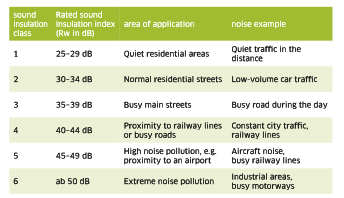
Sound insulation – rediscover peace and quiet
Windows are classified into so-called sound insulation classes according to their sound insulation properties. The decisive factor here is the rated sound insulation value (Rw or Rw,P in dB) – the higher this value, the better the protection against external noise.
Depending on the noise pollution (e.g. from road traffic, railway lines or airports), a window with the appropriate sound insulation class can be selected. Sound insulation class 2 is usually sufficient for residential areas with normal noise levels, while class 4 or higher is recommended for particularly noisy environments, such as main roads.
We offer tailor-made solutions that optimally combine both sound and heat insulation – for more peace and quiet, comfort and energy efficiency in your home.